
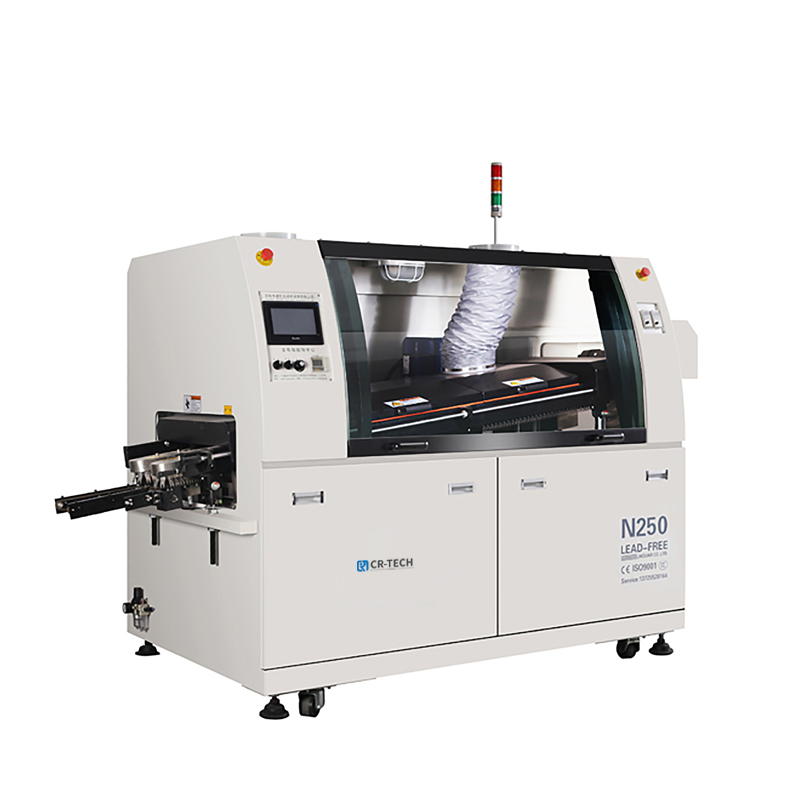
Selective Soldering Showdown: Offline Semi-Auto vs. Inline Fully Auto
Selective Soldering Showdown: Offline Semi-Auto vs. Inline Fully Auto
In through-hole soldering, selective soldering has replaced manual soldering and wave soldering for complex PCB assemblies. However, many SMT managers face a critical bottleneck: choosing between an Offline Semi-Auto Selective Soldering or an Inline Fully-Auto Selective Soldering machine.
With a decade in SMT equipment, I’ll break down the three pillars—Efficiency, Quality, and Cost—to help you decide.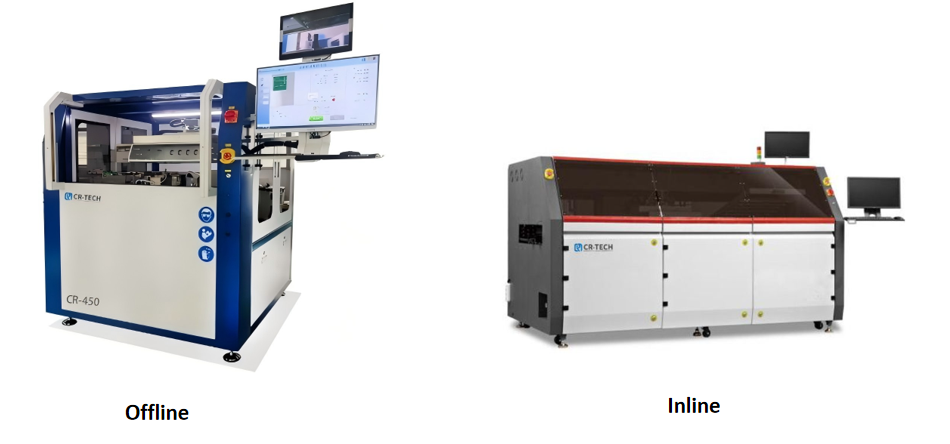
1. Efficiency & Throughput
-
Offline Semi-Auto: These require manual loading and unloading. The operator places the PCB onto the carrier, starts the cycle, and removes it afterward. Typically, the fluxing and preheating are manual or semi-manual. Cycle time depends heavily on operator speed. Ideal for prototypes, small batches, or R&D, but becomes a bottleneck at >50 units/day.
-
Inline Fully Auto: Integrated with your SMEMA conveyor system. PCBs move automatically from the loader to fluxing, preheating, soldering, and unloading without human touch. Multi-station turntables or dual pots allow simultaneous processing. Throughput is 3-5x higher. Perfect for high-mix, high-volume production (e.g., automotive, industrial power supplies).
2. Quality & Process Control
-
Offline Semi-Auto: Quality relies on operator skill. Manual alignment of nozzles to pads can cause bridging or insuffcient wetting. Preheating inconsistencies lead to cold joints or flux residues. However, for low-complexity boards, it’s acceptable. A major risk: ESD damage and positional errors from human handling.
-
Inline Fully Auto: Vision alignment (2D/3D) automatically corrects PCB positioning. Closed-loop temperature control (±1–2°C) ensures stable solder meniscus. Nitrogen inerting (standard on inlines) reduces dross and improves wetting. Results: Zero bridging, <100 ppm defect rates, and consistent through-hole fill (>75%). Traceability systems log every solder profile.
3. Cost Ownership (CapEx vs. OpEx)
-
Offline Semi-Auto: Lower entry cost (60k). Minimal floor space (2–4 sqm). However, labor cost is high (one operator dedicated). Consumables (flux, N2, tip cleaning) are lower because of intermittent use. Hidden cost: scrap rework. A single defective high-value board (e.g., IGBT module) can wipe out the machine’s savings.
-
Inline Fully Auto: Higher initial investment (200k+). Requires more floor space (6–10 sqm + conveyor tails). But ROI is clear: saves 1–2 operators per shift. Lower per-board consumables due to precision flux deposition. For high-volume lines, payback period is often 6–18 months. Also, rework cost drops by 80–90%.
Which One Should You Choose?
| Feature | Offline Semi-Auto | Inline Full-Auto |
|---|---|---|
| Best for | Prototyping, repair, low-mix small batch | Mass production, high-mix large batch |
| Annual volume | <10k PCBs | >50k PCBs |
| Board complexity | Simple THT, large pads | Fine-pitch, dense THT, mixed SMT |
| Operator skill | High (experienced tech) | Low (basic loading only) |
| Typical defect | Bridging, missing joint | Almost none (with recipe) |
Final Recommendation from a 10-Year Insider:
Don’t buy an inline automatic just for “automation’s sake.” If your monthly volume is below 5,000 PCBs or you run engineering samples, an offline semi-auto is a cost-effective workhorse.
But if you compete in automotive, medical, or industrial electronics where quality is contractual and labor is expensive, an inline fully automatic selective soldering system pays for itself in 12 months. It removes human error from every nozzle dip.
One pro tip: Consider a modular semi-auto with future inline upgrade capability. Several Chinese and European brands offer this transition path. Start offline, then add automatic load/unload when your volume crosses the threshold.
Need a DFM checklist for selective soldering nozzle selection? Contact our engineering team for a free guide.