
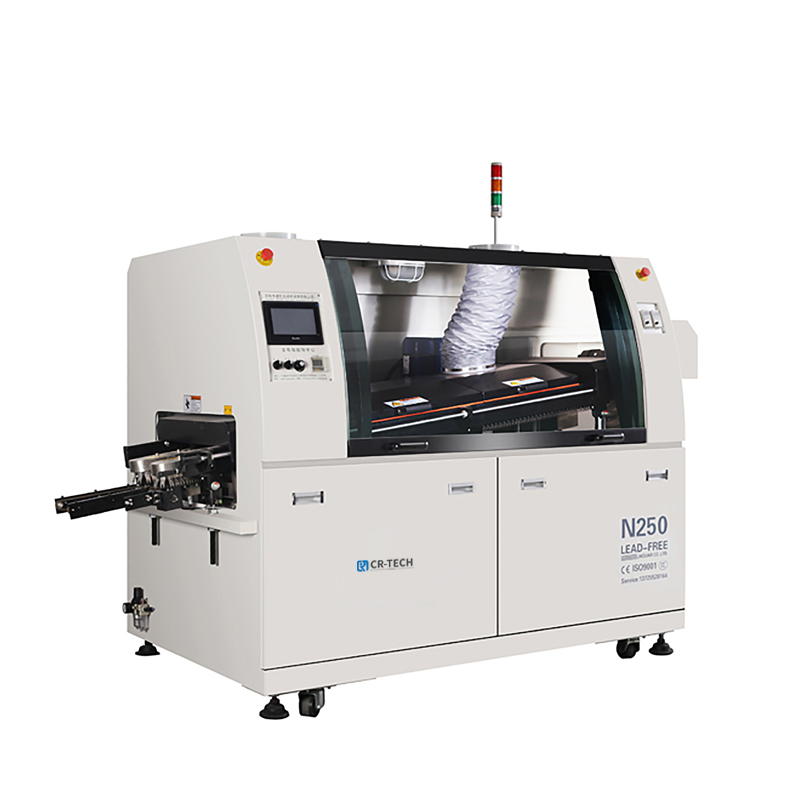
SMT PCB Depaneling Machines: A Complete Guide to Types & Selection
SMT PCB Depaneling Machines: A Complete Guide to Types & Selection
In the SMT assembly process, depaneling—separating individual PCBs from a larger production panel—is a critical final step. While it may seem straightforward, choosing the wrong depaneling method can lead to micro-cracks, solder joint fractures, hidden component damage, and field failures that cost thousands in recalls. With multiple technologies available, how do you select the optimal solution for your production line? This guide breaks down the main types of depaneling machines and provides a practical framework for making the right investment.
1. Understanding the Four Main Types of Depaneling Machines
Each technology serves distinct applications. Here is what you need to know:
① V-Cut (Scoring) Depaneling Machines
These machines use circular blades to separate PCBs along pre-scored V-grooves.
-
Advantages: Low cost, high speed, and simple operation—ideal for high-volume production with straight-line cuts.
-
Limitations: Only works for straight lines; cannot handle curves or irregular shapes. The mechanical shearing force may stress nearby ceramic capacitors or BGAs, risking latent defects.
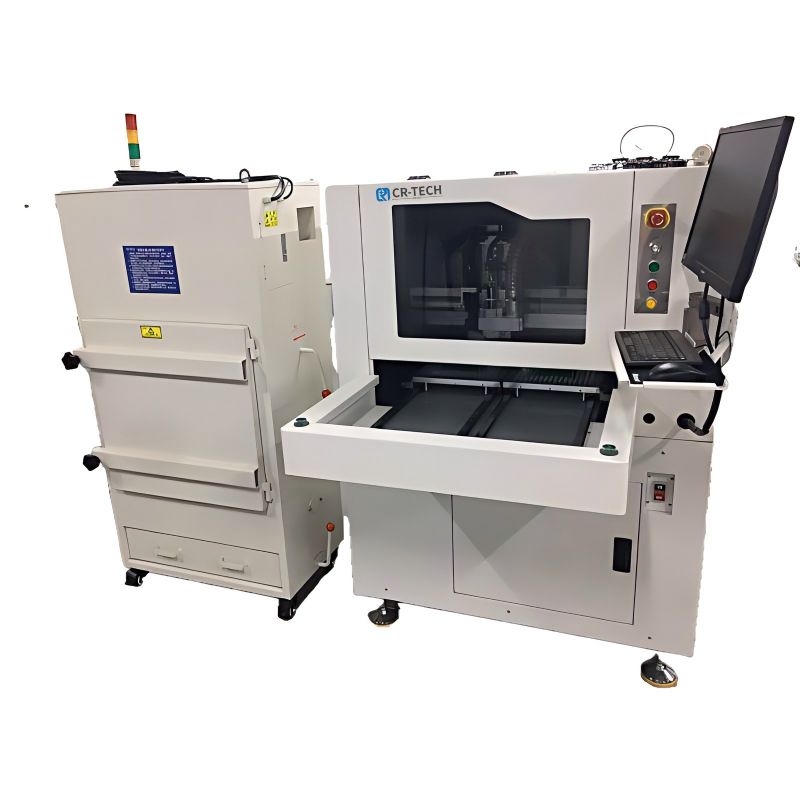
② Router (Milling) Depaneling Machines
Equipped with a high-speed spindle and carbide milling bits, these machines cut PCBs along programmed CNC paths.
-
Advantages: Extremely versatile—handles any shape, including circles, arcs, and complex contours. Delivers high precision (±0.05mm) with smooth edges and minimal mechanical stress.
-
Limitations: Requires periodic cutter replacement as a consumable cost; dust generation necessitates an integrated vacuum system.
③ Laser Depaneling Machines
Using focused UV or CO₂ laser beams, this non-contact method vaporizes the PCB material along the cutting line.
-
Advantages: Near-zero mechanical stress, ultra-high precision (±0.02mm), and dust-free operation. Excellent for thin boards (<0.4mm), flexible circuits (FPC), and panels with components placed extremely close to the edge.
-
Limitations: Higher initial investment; slower cutting speed on thick copper boards; thermal effects must be carefully managed.
④ Punch (Die) Depaneling Machines
These use custom tooling dies to stamp individual PCBs out of the panel in a single stroke.
-
Advantages: Unmatched throughput—ideal for mass production of simple, high-volume boards.
-
Limitations: Requires dedicated tooling per board design; high upfront and maintenance costs; significant mechanical shock limits application to non-sensitive components.
2. How to Choose the Right Depaneling Machine? (4 Key Factors)
Making the right decision goes beyond comparing brochures. Evaluate your specific needs against these four dimensions:
Factor 1: PCB Geometry & Routing Complexity
-
Rule of thumb: If your panel has only straight V-grooves, a V-Cut machine is the most cost-effective choice.
-
If your board includes curves, circles, chamfers, or irregular outlines—which is increasingly common in modern designs—you must choose a router or laser system. No exceptions.
Factor 2: Component Sensitivity & Mechanical Stress Tolerance
This is the most overlooked factor. Ask yourself: Are there any ceramic capacitors, BGAs, or glass diodes within 3mm of the depaneling line?
-
Yes: Avoid V-Cut and punch methods entirely. The shock and bending stress can induce micro-cracks that don't show up until functional testing or field use. Prioritize laser (zero stress) or high-precision router with optimized entry points and step-cut paths to minimize force.
-
No: A standard router machine will provide ample stress control at a reasonable price point.
Factor 3: Board Material & Thickness
-
Standard FR4 boards (0.4mm – 4.0mm): Router machines offer the widest processing window and best overall adaptability.
-
Thin PCBs (<0.4mm) or FPC flexible circuits: Laser depaneling is the preferred solution, as mechanical cutting can cause warpage, delamination, or tearing.
-
Aluminum-based IMS boards: These require robust routers with specific cutter geometries designed for metal-core materials.
Factor 4: Production Volume & Mix
-
High-volume, low-mix (e.g., 10,000+ panels/day of the same design): Consider an inline, fully automated router or laser system with auto-loading/unloading to maximize throughput.
-
Low-volume, high-mix (frequent changeovers): An offline router with quick-change fixture pins and program storage provides the flexibility to switch between different boards in under 5 minutes.
-
Total Cost of Ownership: Don't just look at the purchase price. Factor in cutter bit costs, maintenance intervals, changeover downtime, and, most importantly, the scrap rate. A machine that reduces your depaneling-related defects from 2% to 0.5% often pays for itself within a year.
Final Recommendation
There is no "one-size-fits-all" solution in depaneling. The best choice depends entirely on your product portfolio and production goals.
As a general guideline: Router-type depaneling machines remain the gold standard for most SMT factories due to their perfect balance of flexibility, precision, and operating cost. Laser systems are the premium choice for ultra-thin, flexible, or highly sensitive assemblies where stress must be eliminated. V-Cut remains viable for legacy, straight-line, low-cost boards.
Our expert tip: Always request a sample cutting test before purchase. Run the processed boards through functional testing and cross-section analysis to verify stress levels. A small investment in validation now prevents costly production issues later.