
Automatic Stencil Cleaning vs. Traditional Methods: Efficiency, Quality, Cost & Future Trends
Automatic Stencil Cleaning vs. Traditional Methods: Efficiency, Quality, Cost & Future Trends
Introduction
In the fast-paced world of SMT assembly, the stencil is the unsung hero. It directly dictates solder paste deposition quality, and ultimately, the reliability of the final PCB. Yet, stencil cleaning remains an afterthought for many shops. After a decade in SMT equipment manufacturing, I’ve seen one question repeatedly surface: “Should we stick with traditional manual cleaning or invest in a fully automatic stencil cleaning machine?”
As production densities increase and margins tighten, the answer becomes clear. While traditional methods appear cheaper upfront, they silently erode throughput, quality, and long-term profitability. This article breaks down the key differences, the tangible advantages of automatic cleaning, and where the industry is heading—so you can make a data-driven decision for your SMT line.
Part 1: The Traditional Methods – What Are We Comparing?
When we say “traditional stencil cleaning,” we typically refer to two approaches:
-
Manual Wiping: Operators use lint-free wipes soaked in solvent to scrub the stencil by hand, often followed by compressed air blow-off.
-
Ultrasonic Dip Tanks: Stencils are submerged in a heated cleaning solution with ultrasonic transducers, then manually rinsed and dried.
Both methods have been around for decades. They are low-cost to start and require minimal capital investment. However, their hidden costs—measured in labor hours, inconsistent results, and stencil damage—can quickly eclipse any initial savings.
Part 2: The Clear Advantages of Automatic Stencil Cleaning Machines
Modern automatic stencil cleaners (CR-750) combine spray-jet technology, high-efficiency drying, and programmable cycles. Here’s how they fundamentally outperform traditional methods.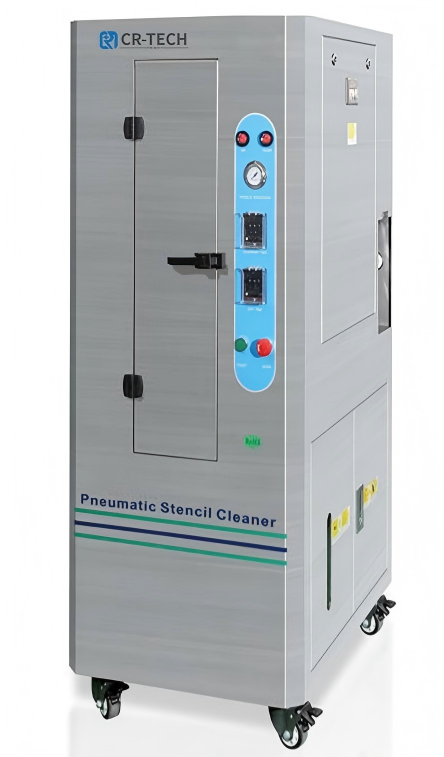
A. Production Efficiency: From Bottleneck to Enabler
-
Traditional: Manual cleaning takes 10–20 minutes per stencil, plus time for inspection and re-cleaning if residue remains. Operators must stop other tasks, creating a scheduling bottleneck. For ultrasonic tanks, add 15–30 minutes for drying.
-
Automatic: Our machine completes a full wash + dry cycle in 3–5 minutes. During that time, the operator is free to load the next PCB or inspect components. Changeover time between jobs is slashed. High-volume shops can clean dozens of stencils per shift without adding labor. Result: up to 70% reduction in downtime related to stencil cleaning.
B. Cleaning Quality: Consistency vs. Variability
-
Traditional: Manual results vary wildly based on operator fatigue, technique, and attention. Underside apertures (especially for 01005 or 0201 components) often retain dried paste, leading to insufficient solder deposition, opens, and rework. Ultrasonic tanks can under-clean fine-pitch areas if cavitation is uneven.
-
Automatic: Our system uses precisely angled, high-pressure spray jets that reach every aperture from multiple directions. A programmable recipe ensures every stencil—whether fine-pitch or standard—is cleaned identically. Wash pressure, temperature, and time are controlled to within 1%. Post-cleaning, a high-velocity hot-air knife eliminates moisture and fiber residue. Aperture release rate improves to >99.5%, directly translating to first-pass yield improvement.
C. Cost Analysis: Total Cost of Ownership (TCO)
This is where traditional methods are most deceptive.
| Cost Factor | Traditional (Manual) | Automatic (Our Machine) |
|---|---|---|
| Labor | High (skilled operator dedicated) | Near zero (automatic cycle) |
| Solvent consumption | High (spills, evaporation, overuse) | Optimized (recycled, precise spray) |
| Stencil damage | Frequent (bent frames, torn foils) | Minimal (non-contact spray) |
| Rework/Scrap due to poor cleaning | Moderate to high | Very low |
| Capital cost | Low | Moderate |
| 12-month TCO | Often 3–5x higher | Lower |
One customer who switched from manual wiping to our automatic cleaner reduced solvent purchase by 65% and eliminated stencil frame damage entirely—saving over $8,000 annually on a two-shift operation
.Part 3: Three Myths About Automatic Cleaning – Debunked
-
Myth 1: “Automatic machines damage fine-pitch stencils.”
Fact: Our spray pressure is precisely regulated (<4 bar), and stencils are fixtured without flexing. Manual scrubbing applies uncontrolled localized pressure, which actually bends aperture walls. -
Myth 2: “They waste too much cleaning fluid.”
Fact: Our machine features a dual-tank filtration system that reuses solvent for hundreds of cycles. Manual wiping evaporates solvent into the air and onto floors. -
Myth 3: “Only high-volume shops need them.”
Fact: For a job shop with 5 changeovers a day, saving 15 minutes per changeover frees 75 minutes daily—that’s over 300 hours per year for productive work.
Part 4: Future Trends in Stencil Cleaning – Where You Should Invest
The SMT industry is evolving, and stencil cleaning technology is following three clear paths:
-
Closed-loop, Smart Cleaning
Sensors will soon measure residual paste in real-time and stop the cycle automatically. Our next-generation machine already includes optional conductivity-based cleanliness verification, eliminating human inspection. -
Environmentally Sealed, Low-VOC Processes
Regulations tighten globally. Future cleaners will use water-based chemistries with closed-loop water recycling. Our current model already supports semi-aqueous and IPA modes, reducing VOC emissions by 90% vs. manual solvent wiping. -
Inline, Fully Automated Cleaning Cells
For Industry 4.0 lines, stencil cleaning will become a robotic cell that receives dirty stencils from a conveyor, cleans them, and returns them to storage—with no human touch. Our machine is designed with SMEMA interfaces for future inline integration.
Part 5: Why Our Automatic Stencil Cleaner Is the Right Choice for Your SMT Line
After comparing all options, one solution consistently delivers higher throughput, better print quality, and lower operating costs. Our model [CR-750] is engineered specifically for demanding SMT environments:
-
Cycle time: 3–5 minutes (wash + dry)
-
Cleaning effectiveness: Removes lead-free, no-clean, and high-viscosity pastes from 0.2mm pitch apertures
-
Cost efficiency: <$0.50 per clean cycle (including fluid, power, amortization)
-
Built to last: Stainless steel construction, industrial-grade pumps, 2-year warranty
Conclusion
Traditional stencil cleaning methods carry invisible costs: lost labor, inconsistent quality, and damaged stencils. Automatic stencil cleaning machines, especially our model, eliminate these variables. They deliver faster changeovers, higher first-pass yield, and lower total cost of ownership.
The future of SMT is automated, data-driven, and clean. Don’t let an outdated cleaning process hold back your modern assembly line.
Ready to see the difference? Contact us for a free on-site stencil cleaning comparison test. We’ll clean your dirtiest stencil with our machine side-by-side with your current method. Let the results speak for themselves.