
SMT BGA Rework Station vs. Hot Air Gun: Why Precision Matters for Your PCB Assembly
SMT BGA Rework Station vs. Hot Air Gun: Why Precision Matters for Your PCB Assembly
Introduction
For electronics manufacturers, BGA (Ball Grid Array) rework is one of the most challenging tasks. When a high-density chip fails, many small repair shops or prototype labs instinctively reach for a traditional hot air gun. But is that shortcut costing you more than you save?
As an independent SMT equipment supplier, we believe in giving you the facts. Below, we break down 5 critical advantages of a dedicated SMT BGA Rework Station over a conventional hot air gun.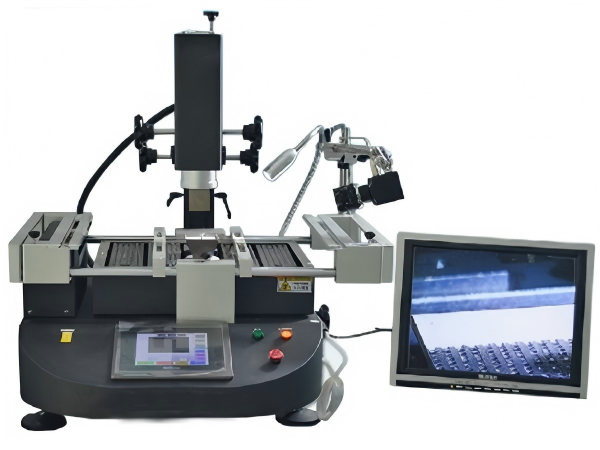
1. Temperature Control: Curve vs. Guesswork
-
Hot Air Gun: Even expensive models offer unstable temperature output. Hot spots, sudden spikes, or airflow shifts can easily burn the board, pop adjacent capacitors, or cause “popcorning” (internal moisture explosion) in BGAs.
-
BGA Rework Station: Uses closed-loop thermocontrol with 3–5 independent heating zones (top, bottom, and preheaters). You can store and recall standard IPC-7530 profiles. Bottom preheating gradually warms the entire board, reducing thermal shock by over 60%.
2. Avoid Board Warpage & Component Damage
BGAs hide their solder joints under the chip. With a hot air gun, you heat from the top only. Large PCBs (>150mm) warp under uneven expansion, ripping pads or cracking solder balls.
A BGA rework station heats from both sides. The bottom IR preheater keeps the whole board at 100–150°C while the top nozzle targets the chip. This eliminates bowing, protecting adjacent BGAs and delicate layers.
3. Precision Alignment: No More “Tombstone” BGAs
BGAs self-align only if the solder melts uniformly. But how do you place a new chip accurately without X-ray vision?
With a hot air gun, you’re guessing. Misalignment by 0.1mm creates open joints or short circuits.
Professional BGA rework stations include split prism optics or high-definition camera alignment. You see the PCB pads and BGA balls overlapped on a screen, achieving ±0.025mm placement accuracy — essential for 0.4mm pitch BGAs.
4. Rework Yield & Rework Cost per Joint
Let’s run quick numbers. A single high-end BGA (e.g., FPGA or GPU) can cost $50–500.
-
Hot air gun: Typical successful removal/placement yield: 60–75%. You risk scrapping the chip and lifting pads (requiring expensive trace repair).
-
BGA rework station: Yield: 95–98% with proper training. The bottom heater prevents pad lifting, and vacuum pickup handles delicate chips gently.
Over 100 reworks, a hot air gun might destroy 25 boards. A rework station pays for itself within 20–30 uses.
5. Process Documentation & Compliance
If you work with ISO, automotive (IATF), or medical device customers, they require rework traceability.
A hot air gun offers no data.
Our BGA rework stations log every profile (temperature, time, zone power) to USB. You can export reports proving that each chip was reworked within IPC-7711/7721 standards — a must for serious contract manufacturers.
When Is a Hot Air Gun Acceptable?
Honestly? Only for:
-
Removing small passive components (resistors/caps)
-
Prototyping on cheap, single-layer boards
-
Urgent field fixes where the BGA value is under $10
But for production rework, high-reliability industries, or boards with >2 layers, a dedicated BGA rework station is non-negotiable.
Conclusion: Don’t Gamble on BGAs
Your customers trust you to deliver reliable electronics. Using a hot air gun for BGA rework is like using a sledgehammer for watchmaking — it might work occasionally, but the risk is unacceptable.
Looking for a cost-effective, IPC-compliant BGA rework station? Browse our range of semi-auto and full-auto models. We offer free process consultation and worldwide shipping.